Biggest cost
Building insurance
LED payback
1–2 years
Preventive vs reactive
3–5x cheaper
AGM vote needed
Ordinary resolution
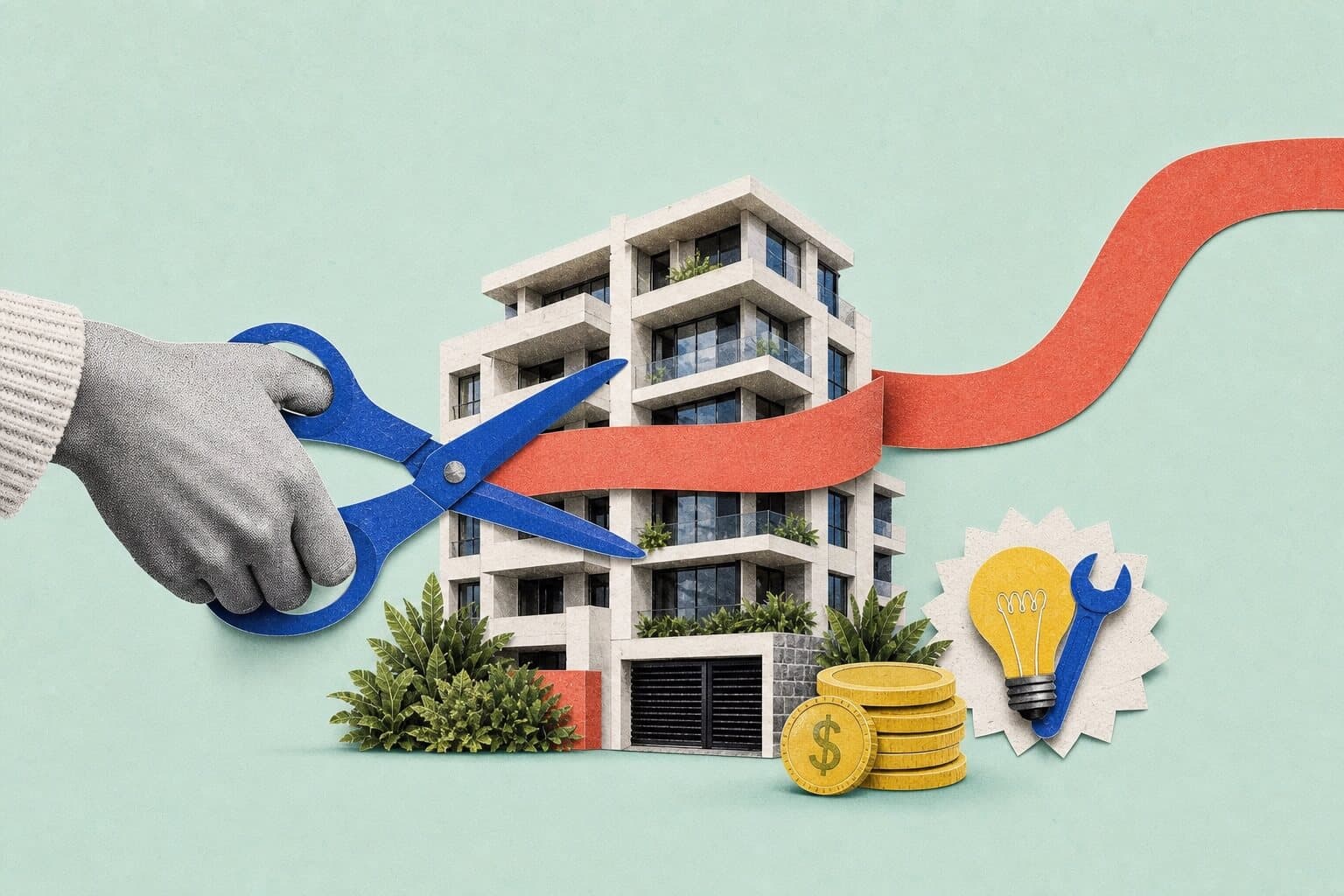
The short version — where the money actually goes
Before you can reduce strata fees, you need to know what drives them. In a typical building, the top three cost centres are:
- Building insurance (30–50%): often the single largest line item, and the one that has increased most sharply in recent years — particularly in flood-prone, cyclone-prone, and high-rise buildings
- Maintenance & repairs (20–30%): cleaning, gardening, minor repairs, lift servicing, fire safety compliance — these recurring contracts add up quickly
- Strata management fees (10–20%): the base fee plus variable charges (Schedule B) for extras like additional meetings, BAS preparation, and debt collection
The strategies below target each of these areas. Most can be actioned through motions at your next AGM.
Potential savings at a glance
| Strategy | Typical Saving |
|---|---|
| LED lighting upgrade (common areas) | $5,000 – $9,000/yr |
| Solar panels (common areas) | $5,000 – $9,000/yr |
| Re-tendering building insurance | 10–30% of premium |
| Switching or renegotiating strata manager | $2,000 – $5,000/yr |
| Competitive re-quoting service contracts | 10–15% per contract |
| Preventive maintenance program | 3–5x vs reactive repairs |
Figures are indicative for a medium-sized residential building (20–50 lots). Actual savings vary by building size, location, and current cost structure.
1. Cut your building insurance costs
Building insurance is typically the largest single expense in the strata budget. A 50-unit complex in Parramatta saw its annual premium jump from $28,000 to $47,000 in two years — a 68% increase. Premiums across Australia have risen 30–50% since 2019, driven by natural disasters, rising construction costs, and insurer exits from the strata market.
The good news: the 2025–2026 insurance market is softening, with new underwriters entering the strata space. This is the time to push for competitive re-quoting.
Go to market every year
Never auto-renew your building insurance. Your strata manager should work with an insurance broker who obtains at least three competitive quotes annually. If your manager is not doing this, raise it at the AGM.
Increase your excess
A $2,000 general excess is now standard. Requesting quotes with a $5,000 or $10,000 excess can meaningfully reduce premiums — but increases out-of-pocket costs per claim. This trade-off works best for buildings with a low claims history.
Reduce claims frequency
Avoid lodging small, frequent claims. Insurers penalise schemes with high claims frequency at renewal. A $3,000 water damage claim might save money now but cost $5,000+ in premium increases over subsequent renewals.
Maintain the building
Schemes that can demonstrate regular, documented maintenance — particularly waterproofing, fire safety, and electrical compliance — attract more competitive premiums. Unaddressed defects can result in declined coverage or massive premium loading.
Demand commission transparency
Under NSW's 2025 strata reforms, strata managers must disclose insurance commissions and broker fees. Ask for this breakdown — it may reveal your manager is steering you to insurers who pay them the highest commission rather than the most competitive premium.
Check your sum insured
Over-insuring wastes money; under-insuring creates risk. Get a professional replacement valuation every 3–5 years to ensure you are insured for the correct amount.
Queensland: Cyclone Reinsurance Pool
2. Energy efficiency upgrades
Common area electricity — lobbies, hallways, car parks, lifts, pools — is a recurring cost that most buildings can reduce significantly with relatively low-cost upgrades. Lighting alone typically accounts for around 90% of common property energy expenses in residential strata.
LED lighting with motion sensors
Replacing fluorescent tubes and halogen downlights with LEDs is one of the highest-return upgrades available. A 43-unit building in Victoria replaced 159 fluorescent tubes with 104 LED lights in its car park — annual energy savings of $8,700 and an 85% reduction in car park energy consumption. The payback period was under 2 years, and light output actually improved by 20%.
Adding motion sensors in car parks, stairwells, and storage areas eliminates unnecessary 24/7 operation. The marginal cost of sensors during an LED upgrade is minimal and dramatically extends the savings.
Solar panels on common property
Solar panels can reduce common area energy costs by 25–50%. A building with a $50,000 system could see annual savings of around $8,900 for the block — roughly $990 per household in a 9-lot scheme. Solar requires a special resolution at a general meeting and a by-law for installation on common property.
Timer systems and daylight dimming
Lobby and hallway lighting often runs at full brightness 24 hours a day. Daylight sensors and timer systems reduce this to actual need with no impact on safety or amenity. Combined with LEDs, these controls can cut lighting costs by 75% or more.
HVAC maintenance and smart controls
For buildings with central heating/cooling in common areas, regular servicing and smart thermostats can reduce HVAC energy costs by 20–40%. Smart thermostats alone typically deliver 10–15% savings.
Government grants for strata solar
3. Negotiate strata management fees
Strata management fees have two components: the base fee (Schedule A) covering routine administration, and variable fees (Schedule B) covering extras. Many owners focus on comparing base fees, but Schedule B charges commonly add 20–50% on top of the base fee annually — and this is where costs blow out.
Typical base management fees by state
| State | Base Fee Range |
|---|---|
| NSW | $250 – $550 per lot/yr |
| VIC | $300 – $500 per lot/yr |
| QLD | $300 – $600 per lot/yr |
| Small schemes (<10 lots) | $3,000 – $5,000/yr flat |
Common Schedule B charges to watch
| Service | Typical Charge |
|---|---|
| Additional committee meetings | $180 – $350/hour |
| After-hours call-out surcharge | 25 – 50% premium |
| BAS preparation | $150 – $300/quarter |
| Insurance claim processing | $100 – $250 per claim |
| Debt collection notices | $60 – $120 each |
Compare total cost, not just the base fee
The cheapest base rate often has the highest variable charges. When getting quotes, ask each manager to estimate total annual cost including Schedule B based on your scheme's typical activity (meetings held, claims processed, arrears notices sent).
Get at least three quotes
Include mid-tier and boutique firms, not just the big names. Smaller firms often provide more personalised service at lower cost for schemes under 30 lots.
Negotiate inclusions into the base
If your scheme consistently holds 2–3 meetings per year, negotiate that number into the base fee rather than paying per-meeting surcharges. Same for BAS preparation if it is a regular requirement.
Review annually, not at contract end
Most management contracts auto-renew. Set a calendar reminder to review performance and costs 3 months before renewal. Check for exit fees and lock-in periods in your current agreement.
4. Re-tender service contracts
Service contracts for cleaning, gardening, lift maintenance, fire safety testing, pool maintenance, and pest control are renewed year after year in many buildings without competitive quoting. This is one of the easiest wins available.
Re-tender every 2–3 years
Track all contract renewal dates and re-tender before they auto-renew. Getting three competitive quotes for each service is the minimum. In NSW, strata schemes must now obtain a second quote for any work exceeding $30,000.
Bundle related services
Companies that offer cleaning, gardening, and waste management together typically offer 10–15% discounts compared to separate providers. This also simplifies administration and reduces the number of invoices your strata manager processes.
Scrutinise line items
Review every line item in your annual budget. Is the accounting/BAS fee justified by your scheme's actual ATO obligations? Is the caretaker delivering value proportional to their fee? Are all recommended equipment replacements in the Essential Services Maintenance report truly necessary, or is the contractor upselling?
Community volunteering
Some schemes supplement professional services with community gardening days or resident-led cleaning rosters for minor tasks. This works best in smaller, engaged communities and can meaningfully reduce landscaping and light maintenance costs.
NSW mandatory second quotes
5. Invest in preventive maintenance
This sounds counterintuitive — spend money to save money — but it is the single most impactful long-term strategy for keeping strata fees down. Emergency and reactive repairs cost 3–5 times more than planned maintenance when you factor in call-out fees, after-hours labour, collateral damage, and the absence of competitive quoting.
A concrete spalling remediation in a Sydney building was quoted at $1.1 million in 2010. The committee delayed. By 2012, the building was approaching uninhabitable conditions and the final repair bill hit $2.15 million — nearly double in two years. Concrete repair costs run $2,000–$3,000 per square metre and escalate roughly 5% annually if left unaddressed.
Waterproofing
42% of NSW buildings surveyed in 2023 had waterproofing defects, and 70% of buildings constructed since 2000 have experienced leaks. Typical rectification for a membrane failure exceeds $70,000 (strip-off, new membrane, screed, retiling). Annual inspections catch problems before they reach this point.
Lifts
Lift components become obsolete 10–15 years after release. Delayed replacement can cause 6–12 month service outages — devastating for high-rise residents and property values. A failed lift can trigger a $15,000+ special levy per lot if the capital works fund is depleted.
The maintenance multiplier
The industry rule of thumb: every $1 invested in preventive maintenance saves up to $4 in future repair costs. A well-maintained building also attracts better insurance premiums, creating a compounding benefit.
Delaying maintenance costs more than it saves
6. Proper capital works fund planning
A well-managed capital works fund (sinking fund in QLD) is the difference between predictable, manageable levies and sudden $10,000+ special levies. Every Australian state requires a 10-year capital works plan, and NSW introduced a mandatory standardised digital format through the Strata Hub portal from April 2026.
Proper planning does not necessarily mean lower fees — it means predictable fees. An owner paying $1,200 quarterly with $300 allocated to capital works might see that component rise to $500 once realistic cost projections are adopted. But this avoids the alternative: a depleted fund and a $15,000 emergency levy when the lift fails.
Engage a qualified quantity surveyor
DIY estimates consistently underestimate future costs. A professional quantity surveyor prepares an accurate 10-year forecast based on the actual condition and expected lifecycle of building components. The cost of the report (typically $3,000–$8,000) pays for itself by preventing underfunding.
Reassess every 5 years
Construction costs, material prices, and building condition change over time. A plan prepared in 2020 may significantly underestimate costs by 2026. Regular reassessment keeps contributions on track.
Consider strata loans for major works
Some schemes use strata loans as an alternative to special levies for major works. This spreads the cost over time and avoids the shock of a large one-off payment, though it does add interest costs.
NSW 2026: new capital works plan requirements
7. Use your AGM effectively
The AGM is where levies are set. If you are not attending and voting, you are leaving money on the table. Levy amounts are approved by ordinary resolution (simple majority of votes cast), so a small group of engaged owners can drive real change.
Submit motions in advance
Contact your strata manager approximately 6 weeks before the AGM to add motions to the agenda. You can propose: obtaining competitive quotes for any service contract, switching strata managers, forming a cost-review sub-committee, adopting electronic communications (reducing printing and postage costs), or amending the proposed budget.
Challenge the budget line by line
Request the draft budget before the AGM and review every line item. Has insurance been re-quoted? Are service contracts at market rate? Is the capital works contribution based on a current plan? Come prepared with specific questions.
Request an audit
If you suspect financial mismanagement or inefficiency, any owner can propose a motion to appoint an auditor. Once approved by ordinary resolution, the books must be audited. Large NSW schemes (100+ lots) already require audited financial statements.
Join the strata committee
Committee members have visibility into day-to-day spending decisions between AGMs. If you want ongoing influence over costs — not just an annual vote — joining the committee is the most direct path.
8. Self-management for small schemes
For very small strata schemes, self-management can eliminate $3,000–$5,000 per year in professional management fees. For a 4-lot scheme paying $4,000 annually, that is $1,000 saved per owner per year.
However, self-management only makes sense when:
- Size: 5 lots or fewer (some sources suggest up to 8, but complexity increases sharply)
- Simplicity: no lifts, pools, central HVAC, or complex mechanical systems
- Skills: at least one committee member with accounting, trades, or legal/admin experience
- Harmony: a community with few disputes — when disagreements arise between neighbours who also manage the building, things get personal quickly
Compliance obligations remain
State grants and programs
New South Wales
- SoAR Grant: Up to $150,000 per building (50% of costs) for solar on strata buildings of 3–55 units. Applications open until December 2026, projects must be completed by April 2027.
- Energy Savings Scheme (ESS): Certificates for eligible energy efficiency upgrades (including LED retrofits) that offset installation costs.
- Mandatory supplier disclosure: Strata managers must disclose connections with suppliers and provide insurance commission breakdowns.
- Financial hardship provisions: Owners corporations must offer payment plans before taking debt recovery action.
Victoria
- Solar for Apartments: Up to $2,800 per apartment rebate (up to $140,000 per property). Available until April 2026.
- Consumer Affairs Victoria provides free guidance and dispute resolution resources for owners corporations.
Queensland
- Cyclone Reinsurance Pool: Delivering quotes up to 38% lower in eligible regions of Northern Australia.
- Strata Resilience Program: Grants covering up to 75% of cyclone mitigation costs ($15,000 per lot, $150,000 per scheme).
- Free conciliation through the BCCM Commissioner's office for budget and fee disputes.
Want to estimate the impact on your levies?
Use our calculator to estimate current strata levies for your property type, then model how changes to insurance, amenities, or building size would affect your quarterly bill.
Use the Strata Fee Calculator →Strata fees are an ongoing cost of apartment ownership — but they are not fixed. By attending your AGM, challenging the budget, and pushing for competitive quoting on insurance and service contracts, most buildings can find meaningful savings without sacrificing maintenance quality. The key is active ownership: the buildings with the lowest fees relative to their size and amenities are almost always the ones with engaged committees and informed owners.
Frequently Asked Questions
Related Calculators
Fee Estimation
Strata Fee Calculator
Estimate quarterly strata levies based on property type, location, and amenities.
Fee Estimation
Special Levy Calculator
Model one-off special levies for building defects or major repairs.
Capital Works
Sinking Fund Calculator
Check whether your capital works fund is on track for upcoming major works.
Related Guides
What Do Strata Fees Cover?
A breakdown of what your strata levies pay for — admin fund, capital works fund, common area maintenance, insurance, and more.
How Are Strata Fees Calculated?
How strata managers calculate your quarterly levies — unit entitlements, budgets, special levies, and what drives costs up.
Average Strata Fees in Australia
Typical strata fees by state, property type, and building size — what's normal, what's high, and what to watch for.
Strata Fees in Sydney — What to Expect
Sydney-specific strata fee ranges by suburb, building type, and age. Benchmarks for apartments, townhouses, and new developments.